
Forty Résumés, One Address
What actually broke in American hiring — and why the fix isn't more applicants.
· 9 min read
One opening. Forty applications received.
All 40 applicants listed the same address.
An employer told me last week that they'd received forty résumés for one opening. All forty listed the same address.
Somebody was playing the numbers game. Fire off enough applications and something eventually lands. That employer's pipeline wasn't full of candidates — it was full of noise. And somebody on their team had to sit down and work through all forty before they even understood what they were looking at.
I've spent twenty years placing people in retail, restaurants and hospitality. I've watched this get worse every year. And I'll say something you don't often hear from someone who runs an AI company:
AI has made hiring worse before it's made it better.
The tool we're using is a hundred years old
Here's the part nobody wants to say out loud. We are still judging human beings off a résumé — a format that has been the standard for close to a hundred years.
That was already a weak signal. Now it's a broken one.
Easy Apply means a candidate can click two buttons and apply to a hundred jobs. Half the time they don't know where they've applied. Candidate pools are saturated. Bots are filling them. And anyone can now produce a résumé that perfectly matches a job description, because the tools to do it are free and take thirty seconds.
So the employer with forty identical addresses isn't an outlier. That's just what the top of the funnel looks like now.
Meanwhile the question that actually matters — will this person still be here in six months? — is one a résumé has never been able to answer.
We're still judging people off a document that stopped telling us anything useful.
The number that should worry every operator
Forget annual turnover for a second. The number that actually tells the story is how fast brand-new hires disappear.
43%
of frontline workers are gone within their first 90 days. They leave before they've gotten good at the job — before they've really contributed anything at all.
That isn't a workforce you're building. That's a bucket with a hole in it. And it's getting worse, not better: the share of new hires still employed at three months fell from 93.9% in 2024 to just 84.6% in 2025. In one year, early quitting jumped by more than half.
Retail runs about 60% annual turnover — you're replacing your entire workforce roughly every 18 months. Each frontline worker who walks costs around $7,000 once you add up recruiting, training, and lost output. A company with 10,000 frontline workers can lose $40 million a year to this — and because 43% leave in the first 90 days, most of that money is gone before those people ever became productive.
That isn't an abstract labor-market statistic. That's a description of what a general manager's week actually looks like. Constantly hiring. Constantly training. Constantly covering a shift for somebody who left.
And every one of those hires runs through the same broken screening process.
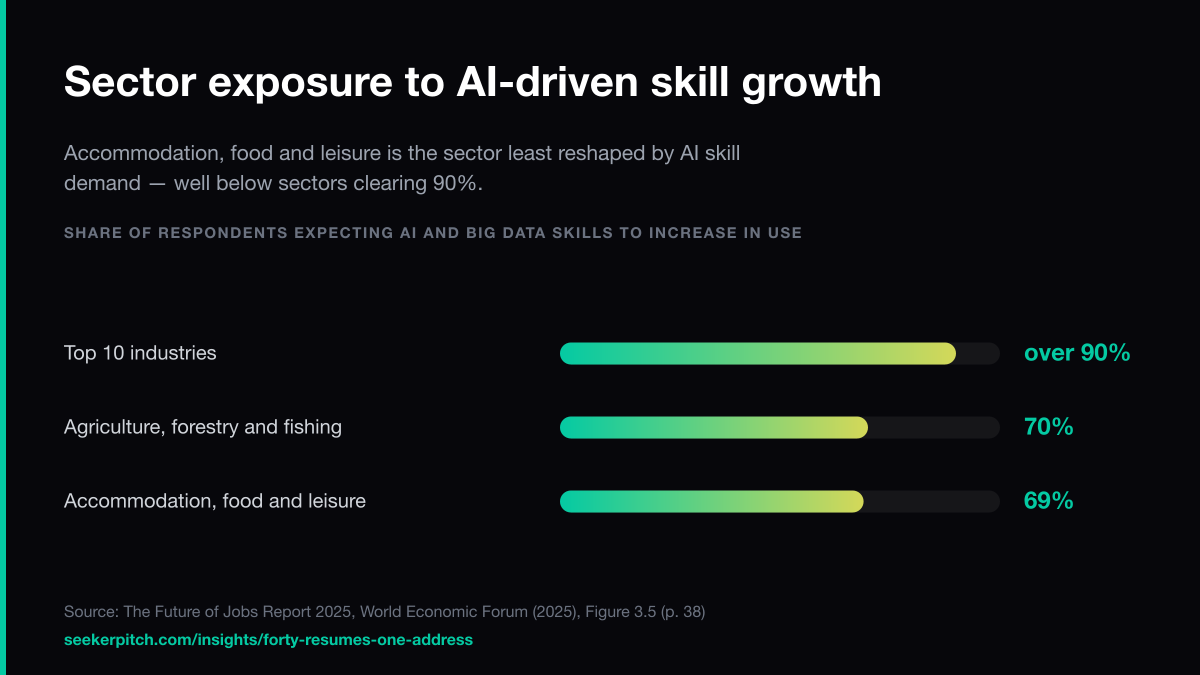
It is also the sector where the technology everyone is talking about has arrived the least.
Sector exposure to AI-driven skill growth
Accommodation, food and leisure is the sector least reshaped by AI skill demand — well below sectors clearing 90%.
Share of respondents expecting AI and big data skills to increase in use
- Top 10 industries
- over 90%
- Agriculture, forestry and fishing
- 70%
- Accommodation, food and leisure
- 69%
Embed this chart
<figure>
  <img src="https://seekerpitch.com/charts/wef/chart-5-sector-exposure.png" alt="Sector exposure to AI-driven skill growth" width="1200" height="675" />
  <figcaption>Chart: <a href="https://seekerpitch.com/insights/forty-resumes-one-address">SeekerPitch</a></figcaption>
</figure>What actually happens in the first 90 days
When someone quits inside the first three months, it comes down to one of two things.
Most of the time, there was a genuine failure on our side — a lack of training, or nobody clearly set the expectations of the role. The rest of the time they were never really interested in the job to begin with. They had one foot out the door from day one and were waiting on an offer somewhere else.
In my experience it's about a seventy-thirty split: roughly seventy percent of early quits come down to training and expectations we didn't get right, and about thirty percent to someone who was always looking for something better.
The research backs that up. In the same 2025 frontline study, workers pointed straight at the first few weeks — unclear expectations, no real onboarding, and never knowing where they stood. A separate recruiting analysis found that the most common reason new hires gave for leaving inside 90 days was a mismatch between how the role was described and what it actually turned out to be.
That first number matters, and I'd rather say it than pretend hiring is the only variable.
Most of the time we didn't hire wrong. We hired fine, and then we failed them.
The variable almost nobody screens for
If you ask me the single biggest reason people stay or leave, it isn't pay. It isn't the generation. It's the manager.
A manager needs three things: the ability to sell, the ability to be empathetic, and the ability to communicate.
When a manager has all three, they give a human being a sense of relief, stability and confidence. That creates attraction. That creates longevity. When you communicate clearly, set expectations, and get someone to agree to those expectations, you create continuity.
The manager is also the one doing the training. They're doing the follow-ups. They're making sure somebody actually learned a process rather than being shown it once on a busy Tuesday.
So when there's instability at the top, that instability runs all the way down. In an industry that's already a revolving door, it compounds — and the pressure, the burnout and the mental health toll land on everyone still standing.
A manager needs the ability to sell, to be empathetic, and to communicate. When they have all three, they give a person a sense of relief, stability and confidence. That creates longevity.
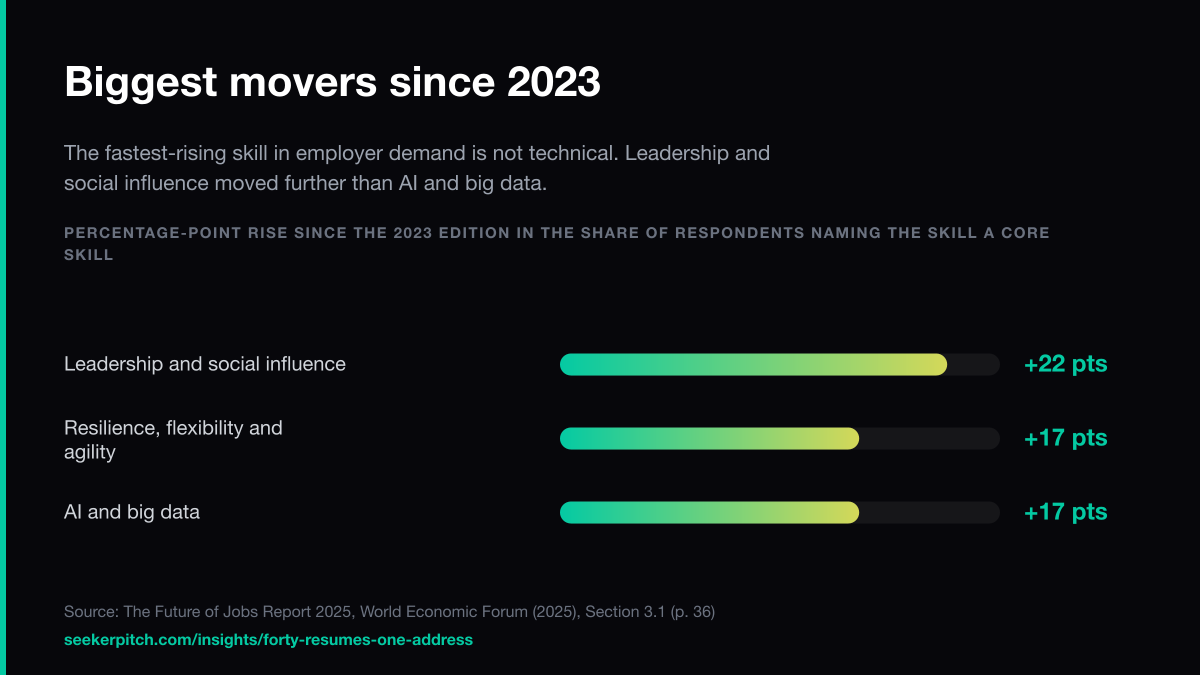
Employers have already noticed, even if their hiring process hasn't caught up: leadership and social influence is the fastest-rising skill in the entire dataset.
Biggest movers since 2023
The fastest-rising skill in employer demand is not technical. Leadership and social influence moved further than AI and big data.
Percentage-point rise since the 2023 edition in the share of respondents naming the skill a core skill
- Leadership and social influence
- +22 pts
- Resilience, flexibility and agility
- +17 pts
- AI and big data
- +17 pts
Embed this chart
<figure>
  <img src="https://seekerpitch.com/charts/wef/chart-4-biggest-movers.png" alt="Biggest movers since 2023" width="1200" height="675" />
  <figcaption>Chart: <a href="https://seekerpitch.com/insights/forty-resumes-one-address">SeekerPitch</a></figcaption>
</figure>Now ask yourself a question. When did you last screen a manager for empathy and communication? Almost nobody does. We check whether they've managed before. We check how many people reported to them. We don't check whether they can hold a team together on the worst night of the month.
Loyalty isn't dead. The trigger changed.
Everyone says workers aren't loyal anymore. I don't think that's quite right.
The days of working at one company for twenty or thirty years — the way the baby boomers did through the manufacturing era — are largely gone. That's true. Gen Z came up differently. Their formative years ran through COVID. They communicate differently. Attention spans are shorter. That's a product of how a generation was raised and educated, not a character flaw.
But loyalty still exists. It just has a different trigger now.
People stay when a company gives them hope and something to work toward consistently. When they know they're making an impact. When somebody has actually helped them figure out what they're interested in and good at.
And in frontline work, the strongest version of that is a visible pathway.
Show someone that working hard, showing up every day, keeping a positive attitude and doing more than the bare minimum leads somewhere specific — and you've given them a reason to stay. But you have to build a culture that actually allows it. Otherwise it's a poster on a break-room wall.
How you give a dishwasher a mission
People push back on this. A dishwasher, a cashier, a server — those jobs don't come with an obvious mission.
You establish it on day one. You say: here's what you can become. And then you point at real people around them who started exactly where they're standing and worked their way up.
That's the American dream. Anybody with a dollar and a dream. You demonstrate work ethic, communication, leadership and vision, and you move.
Any good company can offer a mission and get people to buy into it. Most just never bother to say it out loud on somebody's first day.
What we do differently — and the number behind it
At The Reisner Group we've placed thousands of store managers, department managers, associates, selectors, servers and cashiers.
57%
of our placements over the last seven years are still employed after a full year — across more than a thousand placements, in the same industries where 43% of frontline hires don't survive 90 days.
Sit with that contrast for a second. The industry loses nearly half its new people in three months. We keep well over half of ours for a year — in retail, restaurants, and hospitality, the hardest-churning industries there are. That gap isn't luck. Here's how, and it runs against most hiring advice you'll hear.
We tell candidates how hard the job is.
In the interview, we describe the horrible situations that could genuinely happen. Not the recruiting-brochure version. The real one.
If we're placing someone in retail, we'll say: there may be a day when somebody has an emergency in the bathroom, and you are the person tasked with cleaning it up. You have to be willing to do that. It's part of the industry. There are random, public-facing situations you will not see coming, and you'll have to handle them with a line of customers watching.
If you're not willing to do something like that, maybe this job isn't for you. And it is far better for both of us to find that out in an interview than in the first ninety days.
When people understand the expectations — when they already know what could happen — they're mentally prepared for it. That alleviates the shock factor that causes so much early turnover.
When people know what's coming, they're mentally prepared for it. That alleviates the shock factor.
The part most hiring conversations skip
There's something else driving turnover that rarely shows up in a business article, and I think it deserves to.
You don't know what's happening in somebody's personal life. There could be a death in the family. Somebody sick. Car trouble they can't afford to fix. A relationship falling apart. People arrive mentally checked out, and it flows straight onto the floor.
You need a system of support for that. Somewhere a person feels they can actually say what's going on. The employees who stay longest are very often the ones who'll tell you: I love working here because my manager actually cared, and helped me through something that had nothing to do with work.
Every culture is different, and there's a line between work and personal life that's worth respecting. But pretending people leave their lives at the door is one of the quieter ways we lose them.
EQ is the measurement problem of the next decade
Soft skills are the ones AI will have the hardest time replacing. Emotional intelligence. Leadership. Communication. Teamwork and collaboration. Adaptability and flexibility. Resilience.
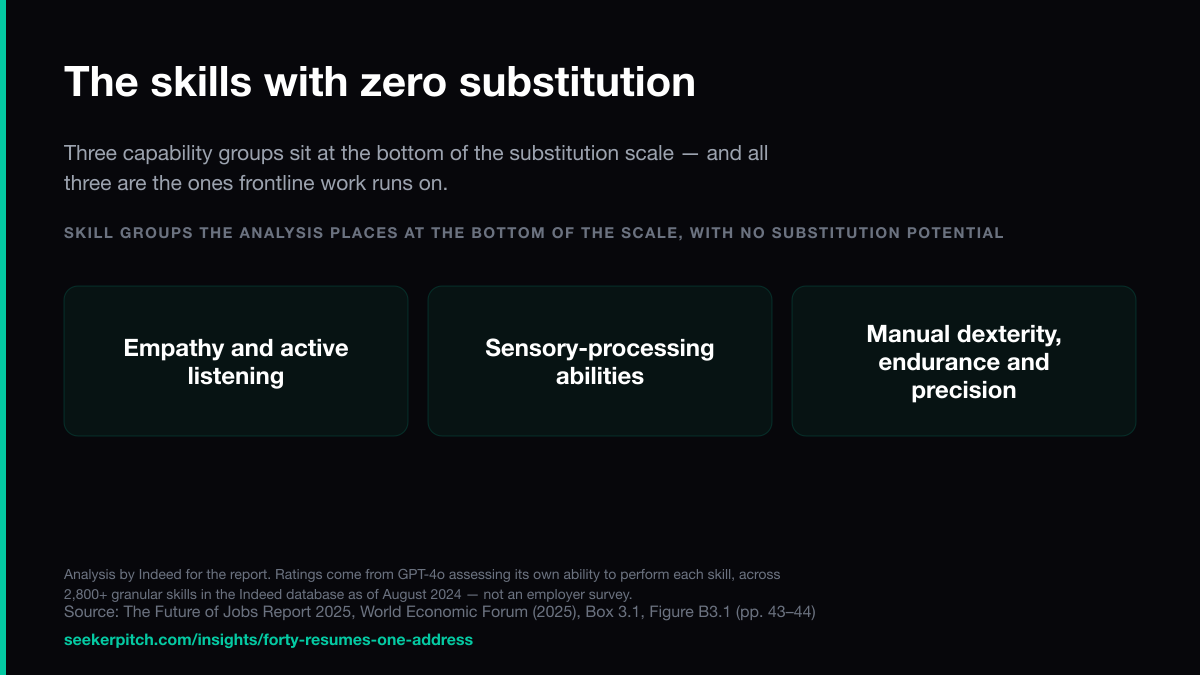
That is not just my read of it. An analysis of more than 2,800 workplace skills could not find a substitute for the three that frontline work runs on.
The skills with zero substitution
Three capability groups sit at the bottom of the substitution scale — and all three are the ones frontline work runs on.
Skill groups the analysis places at the bottom of the scale, with no substitution potential
- Empathy and active listening
- No substitution potential identified
- Sensory-processing abilities
- No substitution potential identified
- Manual dexterity, endurance and precision
- No substitution potential identified
Method: Analysis by Indeed for the report. Ratings come from GPT-4o assessing its own ability to perform each skill, across 2,800+ granular skills in the Indeed database as of August 2024 — not an employer survey.
Embed this chart
<figure>
  <img src="https://seekerpitch.com/charts/wef/chart-2-zero-substitution-skills.png" alt="The skills with zero substitution" width="1200" height="675" />
  <figcaption>Chart: <a href="https://seekerpitch.com/insights/forty-resumes-one-address">SeekerPitch</a></figcaption>
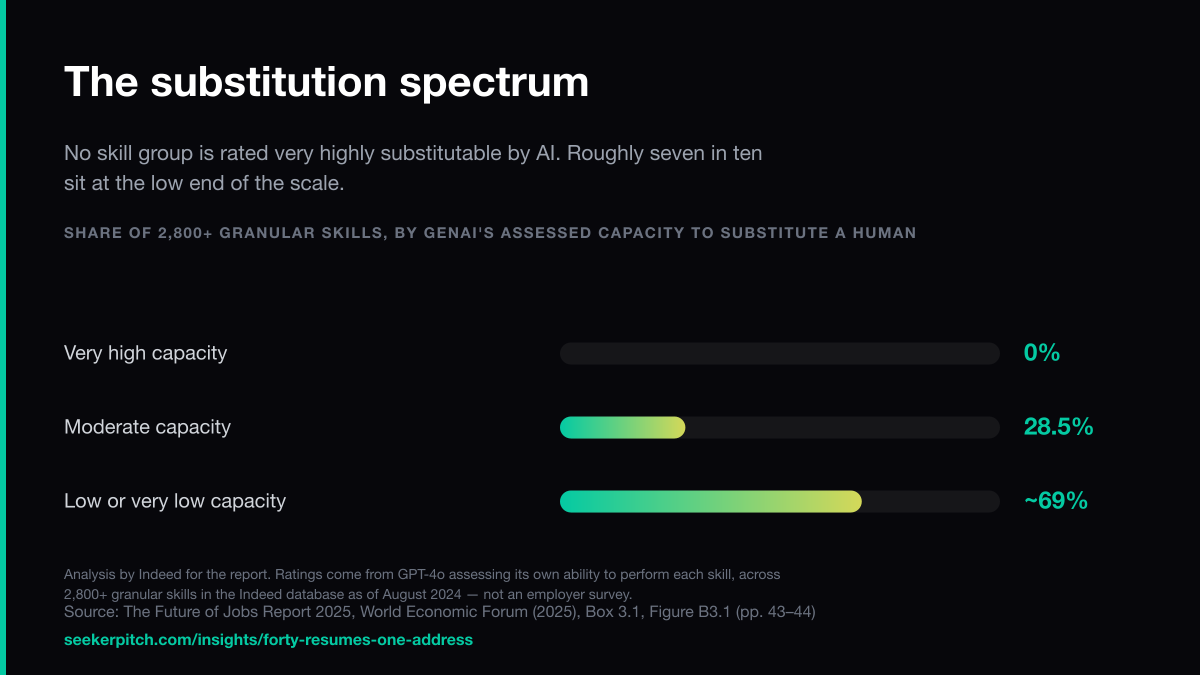
</figure>The substitution spectrum
No skill group is rated very highly substitutable by AI. Roughly seven in ten sit at the low end of the scale.
Share of 2,800+ granular skills, by GenAI's assessed capacity to substitute a human
- Very high capacity
- 0%
- Moderate capacity
- 28.5%
- Low or very low capacity
- ~69%
The report states these three shares only; it does not publish a separate figure for the 'high capacity' band.
Method: Analysis by Indeed for the report. Ratings come from GPT-4o assessing its own ability to perform each skill, across 2,800+ granular skills in the Indeed database as of August 2024 — not an employer survey.
Embed this chart
<figure>
  <img src="https://seekerpitch.com/charts/wef/chart-1-substitution-spectrum.png" alt="The substitution spectrum" width="1200" height="675" />
  <figcaption>Chart: <a href="https://seekerpitch.com/insights/forty-resumes-one-address">SeekerPitch</a></figcaption>
</figure>The hardest one to actually measure — and I say this as someone who has spent years trying — is emotional intelligence. It has four pillars: self-awareness, self-management, social awareness and relationship management. Cracking that is genuinely difficult, and I won't pretend anyone has fully solved it.
But here's why it matters more every year.
EQ is the thing of the future in the age of AI, because IQ has pretty much been thrown into the machine.
Anybody can find an answer faster than ever before. Do you need to be book-smart the way you did yesterday? No.
What matters now is how well you use AI to be more productive — and how well you can adapt, communicate, lead, be likable, read a situation, and connect the dots on where opportunity actually is.
None of that is on a résumé. It never was.
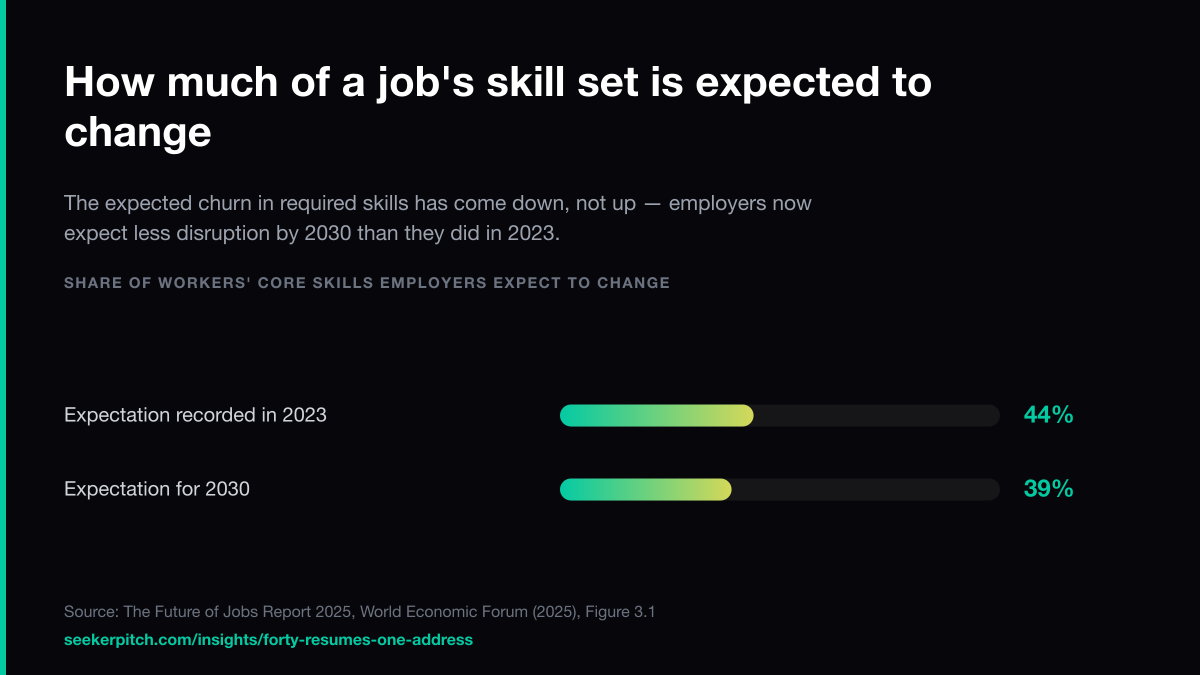
And the churn everyone is bracing for is smaller than it was two years ago, not larger — which says the problem is not that the work is changing faster than people can keep up.
How much of a job's skill set is expected to change
The expected churn in required skills has come down, not up — employers now expect less disruption by 2030 than they did in 2023.
Share of workers' core skills employers expect to change
- Expectation recorded in 2023
- 44%
- Expectation for 2030
- 39%
Embed this chart
<figure>
  <img src="https://seekerpitch.com/charts/wef/chart-3-skills-change-over-time.png" alt="How much of a job's skill set is expected to change" width="1200" height="675" />
  <figcaption>Chart: <a href="https://seekerpitch.com/insights/forty-resumes-one-address">SeekerPitch</a></figcaption>
</figure>What I'm tired of hearing
Go to any industry conference and you'll hear the same sentence: we can't find enough good people. I don't think that's the real problem.
We're at the mercy of the same handful of channels — Indeed, ZipRecruiter, LinkedIn, a company careers page. There's almost no matching on personality fit or culture fit. There's no attempt to match a manager's personality with a candidate's. And almost nowhere shows a candidate a pathway: if I start here today, where can I be in two years, and what are my odds of getting there?
There's a lot of work to be done. But it starts with admitting that judging people off a résumé stopped working — and that adding more résumés to the pile was never going to be the fix.
What you can change this month
Six things that cost nothing
None of these require software. All of them are things I've watched work.
1.Tell candidates the worst part of the job in the interview.
Be specific and be uncomfortable. You will lose some candidates. Those are the ones who would have left in the first 90 days anyway.
2.Say the pathway out loud on day one.
Name a real person who started in that exact role and show where they are now.
3.Screen your managers for communication and empathy, not just experience.
Ask them to walk you through a real conflict they handled and listen to how they describe the other person.
4.Use situational questions, not hypothetical ones.
“Tell me about a time you handled a difficult customer” gets you a rehearsed answer. “It's Friday, two people called out, a table's been waiting forty minutes — walk me through your next ten minutes” gets you judgment in real time.
5.Track why people leave in the first ninety days.
Exit reasons in weeks two through eight are screening feedback. Most operators never write them down, so the same mistake repeats forever.
6.Check in on week two, not week twelve.
The window where you can still save a hire is much shorter than most managers think.
What we built
At SeekerPitch, our AI screener asks behavioral and situational questions and builds what we call a DNA from the answers — including whether somebody can handle a Friday night with high volume, low staff and upset customers.
We're combining pre-hire evidence with performance reviews, attendance records, employment status and exit interview data to find the common denominators in why people actually leave. Then we screen ahead of those patterns and help build training that addresses them.
And here's the part that surprises most operators: candidates prefer it. In that same 2025 frontline survey, 74% of workers said they'd rather go through AI in hiring than the traditional process — because it's faster, it doesn't ghost them for two weeks, and it doesn't play favorites. The thing operators worry candidates will hate is the thing candidates are actually asking for.
The point isn't to remove people from hiring. It's the opposite. We keep a human in the loop on every decision, and we give every candidate a chance to actually show what they can do — instead of being judged on a document that's been the standard for a hundred years and stopped telling us anything useful.
Forty résumés, one address. That's the system all of us have been working with. We can do better than that.
SeekerPitch builds AI behavioral screening for high-volume frontline hiring. If you want to see what this looks like on your own roles, we'll walk you through it in fifteen minutes.
Book a DemoAbout the author
Ryan Reisner is the owner of The Reisner Group and SeekerPitch, Inc. He serves on the board of the Texas Association of Staffing and on advisory boards at the University of Central Florida's Integrated Business program and the Milwaukee School of Engineering's Computer Science and Computer Engineering program.
Sources & notes
- 90-day frontline turnover (43%), annual retail turnover (~60%), per-hire replacement cost (~$7,000), and candidate preference for AI in hiring (74%): Fountain and Lighthouse Research & Advisory, "The Frontline Report 2025," a survey of nearly 2,000 U.S. frontline workers, published December 2025. Note: Fountain sells frontline hiring software and so has a commercial interest in these findings; the survey was run with independent research partner Lighthouse Research & Advisory.
- Three-month new-hire retention falling from 93.9% (2024) to 84.6% (2025), and the role-mismatch finding on early quits: recruiting benchmarks data from Employ, reported by HR Dive, 2025.
- Skill substitutability and skill-demand figures: World Economic Forum, The Future of Jobs Report 2025. The substitutability analysis (Box 3.1, Figure B3.1) was produced by Indeed and rates skills using GPT-4o's assessment of its own ability to perform them — it is not an employer survey and not an independent evaluation of AI. The sector and skill-demand figures (Figures 3.1 and 3.5) are from the Future of Jobs Survey of employers.
- Retention figure (57%), placement volume, and all hiring observations: The Reisner Group's own placement records, 2019–2026. Internal data, not an independently audited benchmark.
- The seventy-thirty split between employer-side causes (training, expectations) and candidate-side causes (leaving for another offer) of early turnover is the author's professional estimate based on his placements, not a study.
- The forty-résumé account was relayed directly to the author by an employer in 2026. The address shown in the graphic above is illustrative.
This article is free to quote with attribution to Ryan Reisner, SeekerPitch, and a link to this page.
Cite this article
Reisner, R. (2026). Forty Résumés, One Address: What actually broke in American hiring — and why the fix isn't more applicants. SeekerPitch. https://seekerpitch.com/insights/forty-resumes-one-address